
The Ambient Era
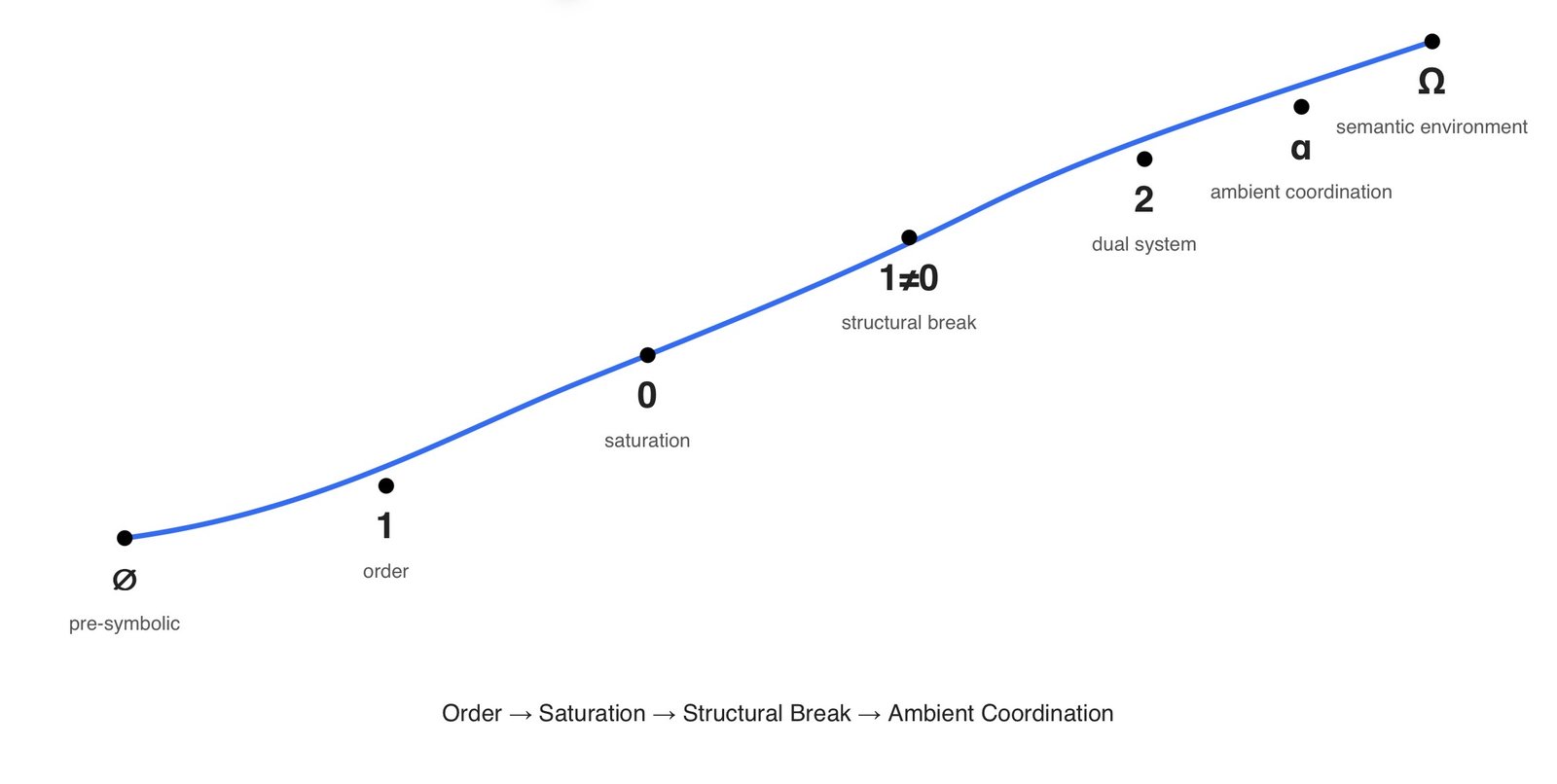
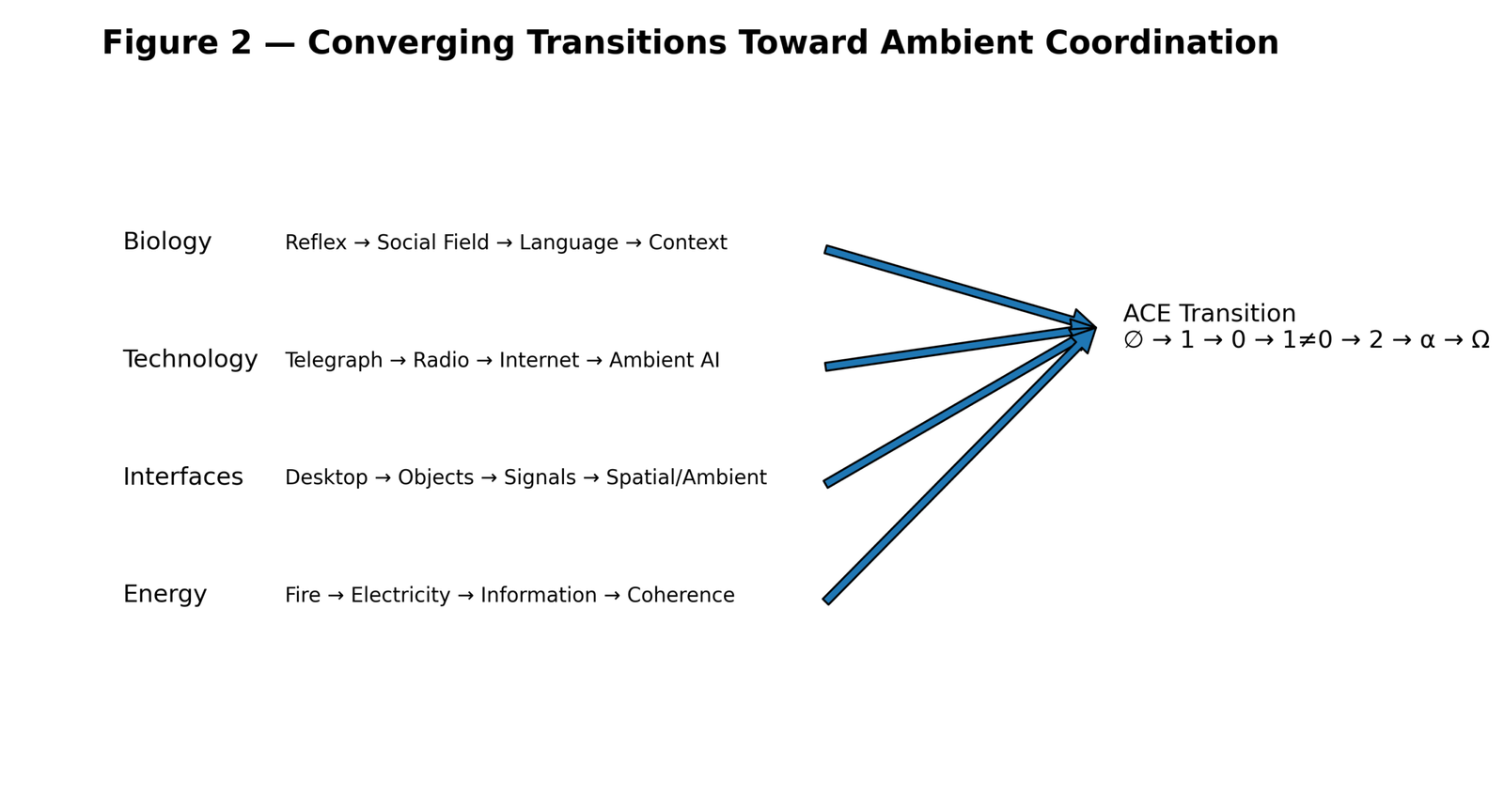
Human communication systems appear to follow a recurring structural transition. Local signals evolve into symbolic networks, eventually saturate, and reorganize into contextual or environmental coordination layers. The Ambient Era Canon formalizes this transition through the ACE sequence: ∅ → 1 → 0 → 1≠0 → 2 → α → Ω
Universal Communication Transitions
Across history, communication infrastructures repeatedly follow a similar structural cycle:
order → scaling → saturation → structural break → new coordination layer
Speech evolved into writing. Writing scaled through printing. Printing transitioned into global digital networks. The internet dramatically increased the scale of symbolic communication, but also introduced new forms of system saturation including attention fragmentation, interpretation overload, and high decoding entropy.
Ambient systems represent a potential structural break in this trajectory. Rather than transmitting meaning primarily through symbolic messages, communication begins to emerge from environmental states. In such systems, meaning is not transmitted only through messages but embedded in shared semantic environments.
The Ambient Era Canon proposes that chromatic semantic vectors can function as a low-entropy semantic substrate connecting human perception, machine vector spaces, and environmental signaling systems.
Research Paper
Eissens, R. (2026). Universal Communication Transitions and the Ambient Model (1.0). Ambient Era Canon — Communication Architecture Series. Zenodo.
This paper introduces a structural model describing recurring transitions in communication infrastructures and situates them within the ACE progression (∅ → 1 → 0 → 1≠0 → 2 → α → Ω) articulated in the Ambient Era Canon.